Good
personal hygiene
1.
Hands
·
Wash
hand regularly and thoroughly
·
Keep
fingernails short and clean
·
Do
not use nail varnish
2.
Skin
·
Uninfected
wounds should be completely covered with detectable (green or blue) water proof
plasters
·
Staff
with cuts and skin infection should not handle food
3.
Hair
·
Shampoo
regularly
·
Hair
must be completely enclosed by suitable head covering, eg hairnets, helmets and
hats
·
Combing
of hair and adjustment of head covering should be done in cloakrooms, before
putting on protective clothing then on food
·
No
hairgrips and clips are allowed
4.
Nose,
ears, mouth
·
Coughs
and sneezes carry droplet infection for a considerable distance
·
Staff
with bad colds should not handle open food
·
Wash
hand after blowing nose
·
No
eating of sweets whilst working
·
No
spitting as it can result in food contamination
·
Staff
with discharges from ears or eyes must not handle food
·
Single-use
paper is preferred, instead of soiled handkerchiefs
5.
Smoking
·
Smoking
is prohibited in rooms containing open food or whilst handling open food as it
can cause food contamination through the fingers touching the lips whilst
smoking
6.
Jewellery
& perfume
·
Should
not wear earrings, watches, jeweled rings or brooches to prevent microbial and
physical contamination
·
Should
not wear strong-smelling perfume as they may taint foods, especially food with
a high fat content
7.
Protective clothing
·
Outdoor
clothing musy not be brought into food rooms. Keep them in the staff lockers or
cloakroom
·
Anti-slip,
unlined and easy to clean boots for wet areas
·
Gloves
should not be left on food contact surfaces
·
Hands
must be thoroughly washed before putting on the gloves
·
Protective
clothing must not be worn outside food premises or for travelling to and from
work
It
is worn to protect the food from risk of contamination


Good sanitation and cleaning procedures
Training
staff should be properly trained and
supervised in cleaning and sanitation.
Purpose:
Training should be used to:
Providing employees with a new level of
competency.
Introduction of various cleaning and sanitization
methods and products to
employees.
Reinforce
existing procedures.
Basic
knowledge of microbial contamination, contamination sources,
and their how to avoid them.
The consequences of microbial contamination and
the risks if appropriate sanitary practices isn’t followed.
Sanitary practices include:
Good housekeeping
Personal hygiene
Equipment operation and design
A clear understanding of each process of
cleaning and sanitization
Proper and safe use of cleaning and sanitizing
agents
Concentration, dilution, and contact time of
cleaners and sanitizers
Product
and chemical residues, including cleaners and sanitizers
The routine log should include:
Date, start and end times of the cleaning
Date,
start and end times of the sanitization; include expiration time
Product and batch preceding the cleaning and
sanitization
MANUFACTURING FACILITY
A. Design
and Maintenance
Buildings should be designed for easy and
effective cleaning and sanitization.
This design should allow minimum cross
contamination.
Building
should have the integrity of the sanitary design.
The layout should be arranged to accommodate the
flow of materials, cleaning operations, in the facility. Separate areas should
be
maintained for material receipt, storage,
weighing, compounding, filling, packing etc.
These surfaces are inclusive of equipment, piping,
under stairs, behind tanks, storage cupboards, walls etc.
The design of building openings should prevent
potential contamination.
Such as, automatic closing doors, screened vents
, screens on windows, sealed pipe entries, and loading bays.
These should be kept in good condition.
External
walls and entry points should be designed to disallow any access to pests,
vermin, birds, and insects.
Building systems, including heat, air
conditioning, and compressed air, should
be monitored to ensure that they do not
contribute to contamination.
Appropriate drainage should be installed to get
rid wastewater.
Equipment
should be elevated from the floor.
Floor, walls and ceiling surfaces should not
have any cracks, crevices, and/or any
open joints.
Finishes should be smooth and non-porous to
allow for easy cleaning and
sanitization.
Peeling
paint must be removed.
Eliminate conditions that contribute to build up
of debris.
Adequate
storage should be provided for items not in use in order to minimize
clutter.
hand washing facilities should be provided.


There are several methods for cleaning and/or sanitizing.
1. Manual
Scrubbing of equipment or parts using a brush,
cloth, or pad using cleaning solution. It is an effective, but very time
consuming method.
2. Soak
Soaking of utensils or equipment parts in containers
with a proper
detergent solution for a span of time.
3.
Spray
Low or high-pressure sprays are used to remove
soil.
4.
Fog
Fogging is a method of creating a mist for the
employment of sanitizers.
This method should only be carried out in closed
systems and by properly
trained personnel or staff members.
A cleaner
(CHEMICAL)
A chemical or a blend of chemicals formulated to
get rid of
undesirable soils from surfaces. These chemicals
are solvents, acids,
bases, detergents and water based chemical
blends. Companies are focusing on
aqueous cleaners because of the concern for the
environment and employee/staff exposure to these chemicals.
A cleaner should be non-corrosive, soluble, have
good wetting action,good penetration properties, good emulsification and soil
dispersion properties, good rinsing properties, economical and readily
available, environmentally friendly and non-hazardous or toxic.
The higher the cleaning process temperature is,
the more efficient and effective the cleaning.
5. Time
Soaking can and will take many hours.
So high pressure sprays are used as they only
require a few seconds or minutes. Cleaning time should be considered in the
validation of the entire cleaning process/system.
6.
Rinse
It is essential to rinse as this procedure
completely removes any debris on equipments during cleaning. Therefore assuring
that there is no cleaner residue.
7.
Drying
To reduce corrosion, prevent any microbial re-growth,
All equipment should be properly dried after
rinsing.
SANITIZERS
“A sanitizer is either a chemical or physical
agent that is effective in reducing microbial contamination on product contact
surfaces.”
Reducing of pathogens and microorganisms as well
as reducing any other organisms to a acceptable level.
B.
Characteristics and Selection of an Efficient Sanitizer
Reducing microbials to 99.9%
And is effective against unwanted and undesired organisms.
Effective in a short contact time.
Non-toxic at use levels.
Non-corrosive.
Compatible with products and equipment.
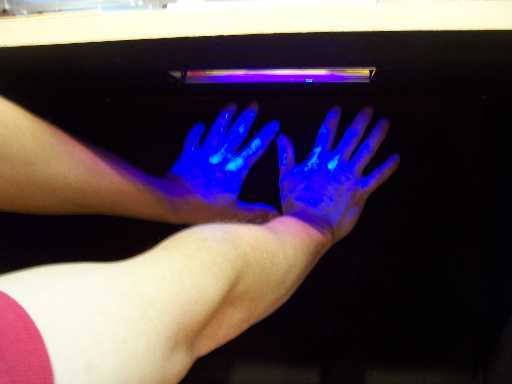
Free from odours and residue.This is an example of filthy hands under black light.
Poor Personal Hygiene
Cleaning methods ,proper sanitation, food storage and personal hygiene are important factors when it comes to food safety. Unclean and unsanitized hands, dirty clothing, messy hair and bad habits are the causes of food contamination; through bacteria, dirt and germs. After consuming the food that is contaminated one might experience illnesses such as food poisoning.
Problems due to bad
personal hygiene, cleaning and sanitation:
- Outbreak of food borne
illnessesPersonal: - medical fees, loss of work time.To
the company: discarding of food, bad reputation which leads to the loss of
customers , fewer sales, loss of production time, legal fees, high cost for
insurance coverage.Individual
employer’s: productivity losses, hiring temporary staff and shortage of staff,
new inexperienced employees.
Respiratory diseases:
Colds, Sore throats, Pneumonia, Scarlet, Fever,
and Tuberculosis
Gastrointestinal diseases:
Vomiting, Diarrhea, Dysentery,
Typhoid
Other symptoms include:
-Fever
-Infectious
-Hepatitis
Hands should be washed
before entering the food handling area, as well as after using the bathroom,
using a tissue, eating, drinking, smoking, using cleaning supplies or handling
raw food
- To prevent food borne illnesses
as microorganisms can be transmitted to the food
- Entry into the food, for example via fruits,
vegetables or fish and shellfish;
- By providing breeding sites for flies and
insects that spread diseases;
- Problems
include sticky residue on pans, rust in the ice machine and the fact that the
grill,
refrigerators ,floors, walls and ceiling all need cleaning.
refrigerators ,floors, walls and ceiling all need cleaning.
- Accumulation
of grease
During our research on Prata Paradise, we observed the unsanitary habits of the shop.


This is what we found:
1. Never wear gloves for ready to eat
food (peanut, ikan billis)
2. Same person that prepared food was
handling dishwashing stuff and did not wash his hands.
3. No proper footwear (slippers and
sandals)
4. Wearing shorts (risk of
staphylococcus areus)
5. No apron
6. Attire observed is from home (clothes
wear from home to workplace)
7. Did not wash hands before serving
food.
8. No separate equipment for food
preparation and cleaning.
9. Not washing of hands after mopping.
10. Soiled plates, bowls, utensils have no proper
storage area before washing (allowing pest to infest)
11. Good morning cloth used to wipe surfaces
repeatedly without washing
12. No proper sanitizer spray for cleaning
surfaces
13. Hands not washed after reading newspaper
14. Teh terik brought from kitchen to dishwashing
area and disposal area (workflow is not smooth and risk of cross contamination)
15. Using his hands to remove ice from the scoop
he has used.
16. Handling of money and food
Kitchen:
Clumping of equipment and no accessibility for cleaning
This blog is quite informative on personal hygiene. However, I think that it is lacking in information about explaining the rationale of good personal hygiene. Despite that, I liked the fact that you guys had a specific case study to indentify the poor practices of personal hygiene. Good job guys. :)
ReplyDeleteThey were observant in identifying the poor practices of personal hygiene on Prata Paradise. They lacked information in the rational of good personal hygiene but provided in depth information on ensuring an appropriate degree of personal cleanliness.
ReplyDeleteThis blog provides enough informations about personal hygiene which even includes the kitchen layout. Yet, There is less pictures shown to people on how can we maintain our personal hygiene. Thus, this blog has room for improvements.
ReplyDeleteThis comment has been removed by the author.
ReplyDeletePersonally, this blog has Prata Paradise shop as a base case study for the information of this blog. They also had the information related to the kitchen layout which I felt was a good idea. However, I feel that this blog could be improve as it was too wordy. Readers would lose interest in checking out the information.
ReplyDeleteI feel that the blog has alot of information which is good. You have also done a good job in designing the layout. It'd be good if it is presented in an more interesting way, for example, less words or more pictures.
ReplyDeleteYuanKai:
ReplyDeleteI like the background of the blog but this has no link to hygiene. The blog was informative but i think it could be in different post. It is one whole chunk and it hard to keep on scrolling down.
I'd recommend to split up the information in this post to several posts as it is too wordy. However, beside the organization, I feel that the information of this blog is adequate and useful for our subject.
ReplyDeleteMichelle
Good that they have given the methods of sanitization and cleaning methods. Everything is good. But it is too wordy, they should have catergorized it further.
Jacqueline
Firstly, the blog is too wordy. secondly, the blog should be categorized properly instead of squeezing everything into one. lastly, the information is good. methods of sanitizaton and cleaning is good. but more depth is required.
Jiajun
The blog was a bit hard to read because it was rather lengthy and wordy. More elaboration can be made instead of just listing down. More pictures can be added and perhaps a video. However, I like their case study on the Prata shop.
Mariah